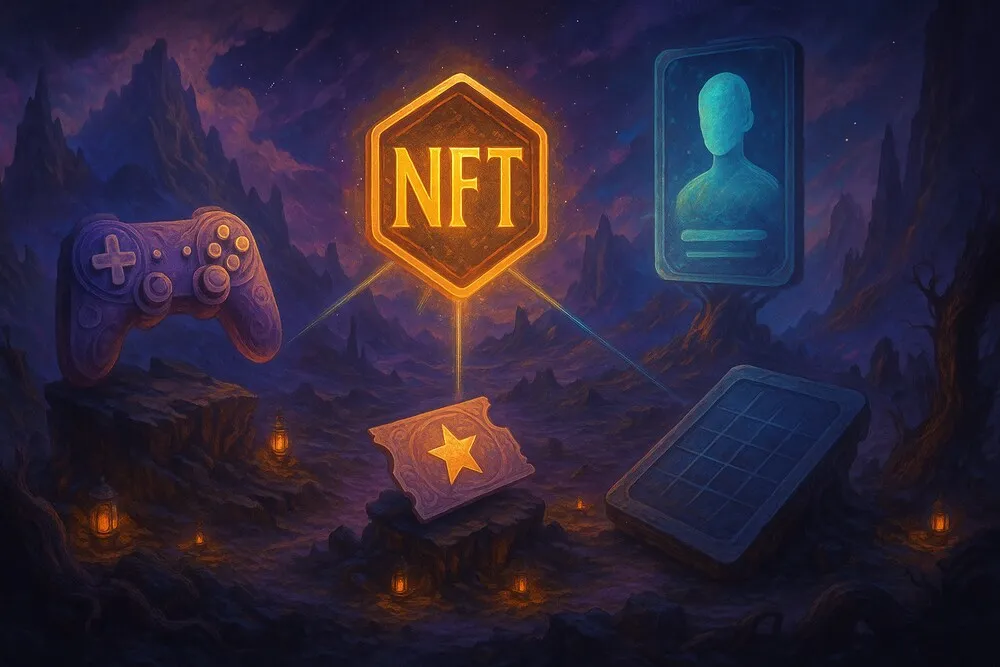
The NFT industry is changing its pitch.
For years, non-fungible tokens were largely associated with digital artwork, profile pictures and collectible communities. During the height of the NFT boom, ownership of a scarce digital asset could become a cultural statement, an investment thesis and, in some cases, a status symbol.
But that era is no longer defining the entire market.
As the broader digital-asset industry matures, attention is increasingly shifting toward what NFTs can do rather than what they simply represent.
Memberships, gaming assets, event access, digital identity, intellectual property and tokenized ownership are emerging as important areas of experimentation. The shift does not mean collectibles are disappearing. Instead, the technology behind NFTs is being reconsidered as a mechanism for establishing verifiable digital ownership and programmable access.
That could give NFTs a second act.
The Industry Is Moving Beyond the Hype
The first NFT boom introduced millions of people to the concept of blockchain-based digital ownership.
Projects generated enormous attention by selling limited collections, creating online communities and turning digital images into tradable assets.
But speculation also became the dominant narrative.
Prices rose dramatically, new collections appeared almost daily and investors often purchased NFTs primarily because they expected someone else to pay more later.
When market sentiment changed, demand collapsed across much of the sector.
The downturn exposed an important weakness.
An NFT could be scarce, but scarcity alone did not guarantee lasting value.
That realization has encouraged developers and creators to explore more practical applications.
The industry is increasingly asking a different question:
What can an NFT give its owner that a conventional digital file cannot?
Utility Is Becoming the New Selling Point
NFT utility can take many forms.
An NFT could provide access to an online community, unlock exclusive content, act as a membership credential or give its holder access to an event.
It could also function as a digital certificate representing ownership, participation or a particular achievement.
The underlying technology remains the same: blockchain infrastructure can provide a transparent record showing that a particular wallet controls a particular digital asset.
What changes is the purpose.
Instead of purchasing an NFT solely because it might appreciate, a user could acquire one because it provides an ongoing benefit.
That distinction could fundamentally change how NFT projects are designed.
Gaming Could Be a Major Testing Ground
Gaming remains one of the most obvious areas where NFT utility could develop.
Players already spend enormous amounts of money on digital items, including skins, characters, weapons, accessories and other virtual assets.
NFTs introduce the possibility of making some of those assets transferable and independently verifiable.
In theory, a player could own a digital item outside the boundaries of a single game ecosystem.
Developers could also create assets that interact with multiple experiences or provide benefits across an interconnected digital environment.
However, mainstream adoption is not guaranteed.
Gamers have frequently criticized blockchain projects that appear to add tokens or NFTs without providing meaningful improvements to gameplay.
The lesson for developers is becoming clearer: blockchain technology has to serve the game, not the other way around.
If NFT ownership creates genuine benefits for players, adoption could follow naturally.
If it feels like another monetization mechanism, users may reject it.
NFTs Could Become Digital Membership Cards
Membership is another promising application.
Businesses, communities and online platforms can use NFTs as verifiable credentials that provide access to exclusive benefits.
Instead of maintaining a traditional membership database, an organization can issue blockchain-based assets that users hold directly in their wallets.
The NFT could unlock private communities, events, discounts, experiences or digital content.
This model also creates an interesting secondary-market possibility.
Traditional membership credentials are generally non-transferable.
A blockchain-based membership asset can potentially be transferred when the issuer allows it.
That creates a new relationship between ownership and access.
However, businesses still need to determine whether blockchain actually improves their membership systems.
The technology is most compelling when it solves a problem rather than simply adding complexity.
Events Could Give NFTs Real-World Utility
Ticketing is another area where NFTs could offer practical advantages.
A blockchain-based ticket can provide a verifiable record of ownership while potentially allowing organizers to attach additional information and benefits.
An NFT ticket could, for example, provide access to an event while also unlocking merchandise, exclusive content or future benefits.
This could make tickets more than simple entry passes.
They could become persistent digital objects that retain value or utility after the event itself.
There are still important challenges, including user experience, transaction costs, privacy and regulatory considerations.
But the concept demonstrates why NFT utility extends far beyond digital artwork.
Digital Identity Is an Even Bigger Opportunity
NFT technology could also contribute to the development of digital identity.
A blockchain-based asset can prove that a particular wallet controls a specific credential without necessarily requiring a centralized database to manage ownership.
That opens possibilities for professional credentials, memberships, certifications and reputation systems.
The concept is particularly interesting in online environments where users interact across multiple platforms.
Instead of rebuilding an identity from scratch on every service, users could potentially carry certain verifiable credentials with them.
But identity applications require significantly stronger privacy protections than collectible NFTs.
Public blockchains are designed for transparency, while identity systems often require selective disclosure.
Solving that tension will be essential.
The Creator Economy Is Watching Closely
NFTs could also provide creators with new ways to distribute and monetize digital work.
Artists, musicians, writers and other creators can use blockchain-based assets to establish verifiable ownership and create direct relationships with audiences.
The important development is that creators no longer have to think about NFTs simply as digital collectibles.
An NFT could provide access to a creator’s private community, unlock exclusive work or act as a digital pass for experiences.
This creates a potentially deeper relationship between ownership and participation.
Instead of selling a digital object once, creators could build an ecosystem around it.
That could make NFTs more sustainable over time.
Brands Are Experimenting With Digital Ownership
Major consumer brands have also explored NFTs as tools for digital engagement.
The most successful implementations may not necessarily look like traditional NFT projects.
Consumers might not even realize that blockchain technology is involved.
A loyalty program could issue blockchain-based digital collectibles. A fashion company could create digital versions of physical products. A sports organization could offer fans verifiable digital memorabilia or access credentials.
This suggests an important shift.
The future of NFTs may involve less emphasis on the term “NFT.”
Consumers may simply interact with digital assets that happen to use NFT infrastructure underneath.
That could be a sign of genuine mainstream adoption.
Interoperability Could Make Utility More Powerful
NFT utility becomes considerably more interesting when assets can move between ecosystems.
Imagine earning a digital credential from one platform and using it somewhere else.
Or owning a game asset that can provide benefits across multiple connected experiences.
This is technically difficult, but interoperability could significantly expand the value of digital ownership.
For that to happen, platforms will need shared standards and reliable infrastructure.
Without interoperability, an NFT may remain locked inside a single ecosystem.
With it, digital assets could potentially become portable pieces of online identity and ownership.
Security and Ownership Still Matter
More utility also creates more responsibility.
If an NFT provides access to an event, financial benefit, digital service or valuable virtual asset, losing control of the underlying wallet can have consequences.
Smart-contract vulnerabilities present another risk.
NFT infrastructure can involve contracts that govern transfers, access rights and interactions with other applications. A flaw in those systems could compromise the asset or the utility attached to it.
Projects therefore need to treat security as part of the product itself.
The more valuable the utility, the more important reliable infrastructure becomes.
Regulation Could Influence the Future
NFTs also occupy an increasingly complicated regulatory environment.
Some digital assets may function primarily as collectibles or access credentials, while others could potentially resemble financial instruments depending on how they are structured and marketed.
That distinction matters.
As NFT projects become more sophisticated, businesses will need to consider consumer protection, intellectual property, taxation and other legal requirements.
Clearer regulatory frameworks could help legitimate projects grow by reducing uncertainty.
At the same time, excessive restrictions could make experimentation more difficult.
The NFT Market May Become Smaller—and Stronger
The future of NFTs may not involve another massive speculative boom.
In fact, the market could become considerably smaller in terms of the number of projects while becoming more meaningful in terms of utility.
That would not necessarily be a negative development.
Thousands of collections competing for speculative capital may be less sustainable than a smaller number of projects providing genuine value to their users.
The industry’s next winners may therefore be determined by adoption rather than hype.
Projects that create useful digital ownership systems could survive long after speculative enthusiasm fades.
NFTs Are Becoming Infrastructure
The most important change taking place in the NFT industry may be conceptual.
NFTs are gradually moving from being viewed primarily as digital collectibles to being understood as programmable ownership and access tools.
That opens a much larger range of possibilities.
They can represent memberships, credentials, tickets, gaming assets, digital merchandise and potentially numerous other forms of ownership.
The technology itself has never been limited to artwork.
The market’s understanding of it was.
Now that understanding is expanding.
The Next NFT Era Could Be About What You Can Do
The NFT industry does not necessarily need another collection selling for millions of dollars to prove that the technology matters.
It needs users to find NFTs useful.
That could mean carrying a digital membership, accessing an event, owning an in-game asset, proving a credential or interacting with a creator in a new way.
If those applications gain traction, the NFT market could eventually move beyond the cycle of hype and speculation that defined its first major boom.
The most valuable NFT may no longer be the one with the rarest image.
It could be the one that unlocks something you actually want.
And that shift—from collecting digital assets to using them—could determine whether NFTs become a lasting component of the digital economy or remain primarily a fascinating chapter in crypto’s history.