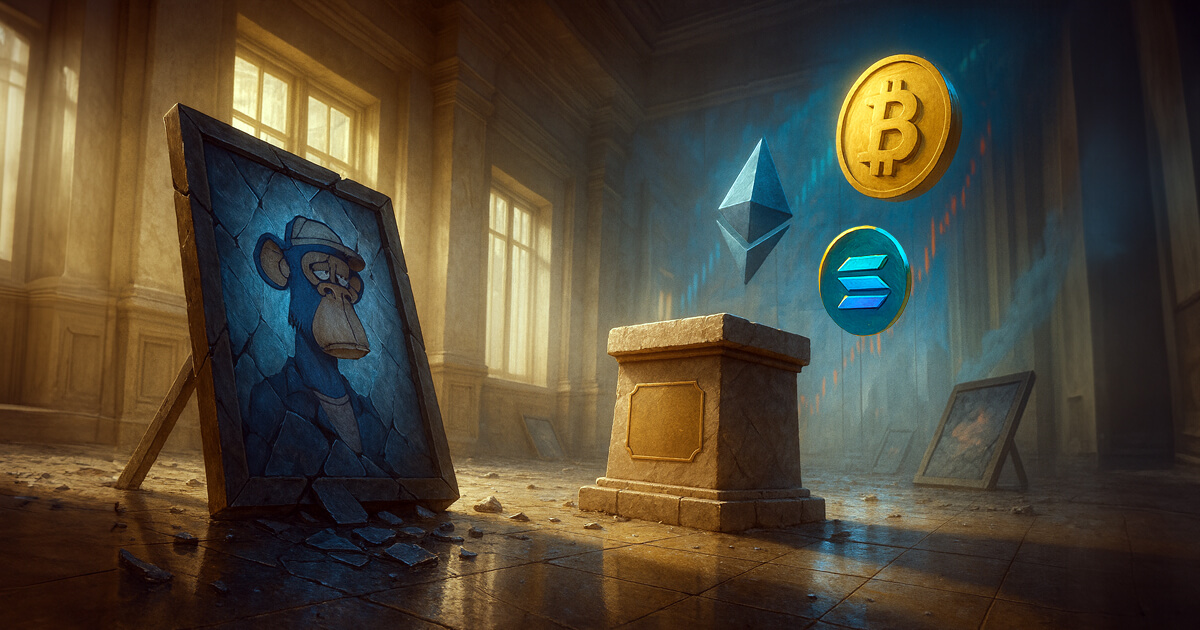
The NFT market has already experienced one of the most dramatic rises and falls in the history of digital assets.
During the 2021–2022 boom, NFTs moved from a niche blockchain concept into mainstream culture almost overnight. Digital artworks sold for extraordinary sums, celebrities launched collections, major brands entered the space, and investors rushed to discover the next big project.
Then the excitement faded.
Trading activity contracted. Speculative collections lost momentum. Many projects disappeared from public attention, while the broader market began questioning whether NFTs were a genuine technological innovation or simply another speculative cycle.
But writing NFTs off completely may be premature.
The next NFT comeback, if it happens, is unlikely to resemble the previous boom.
It may be quieter.
More selective.
More practical.
And perhaps far more interesting.
Instead of another wave built primarily around profile pictures and speculation, the next chapter could be driven by utility, digital ownership, gaming, identity, memberships and real-world applications.
The NFT industry may not need another hype cycle.
It may need a reason to exist.
The First Boom Was About Attention
The previous NFT explosion was largely powered by scarcity and attention.
A limited collection could generate enormous interest simply because people believed its value might increase.
Social media amplified the effect.
A project could become popular within days, creating a feedback loop of attention, buyers and rising prices.
But attention is difficult to sustain.
When prices began falling, the underlying weaknesses of many projects became visible.
Some had little utility beyond speculation.
Others struggled to maintain communities.
Many relied heavily on constant new buyers entering the market.
The result was a brutal separation between projects with genuine staying power and those built primarily around momentum.
That experience changed the market.
And that change may be the foundation for the next NFT era.
The Market Has Become More Selective
Today’s NFT environment is considerably different from the frenzy of 2021.
The Block’s 2026 outlook describes the sector as increasingly concentrated, with a relatively small group of projects and ecosystems retaining meaningful activity while a large portion of older collections has faded.
That may sound negative.
But market consolidation can also be a sign of maturation.
When almost any project can attract attention, it becomes difficult to determine which ones actually provide value.
When speculation declines, stronger projects have to demonstrate why they deserve users.
The result is a market where the question is no longer simply:
“How much could this NFT be worth?”
It is increasingly:
“Why would anyone want to own this?”
That is a much harder question.
It is also a much more important one.
Utility Could Become the New Growth Engine
The strongest argument for an NFT comeback is utility.
NFTs can function as more than digital images.
They can represent access, membership, tickets, credentials, gaming assets and other forms of digital ownership.
This changes the relationship between the user and the asset.
If an NFT provides access to a service or experience, its value does not necessarily depend entirely on speculative resale.
It has a function.
That could make utility-focused NFTs more resilient than purely speculative collections.
The broader digital-asset market is already showing greater interest in utility-driven applications, with recent industry research highlighting growing attention toward tokenization and practical digital-asset infrastructure.
NFTs could benefit from the same shift.
Gaming Could Lead the Next Wave
Gaming remains one of the most compelling environments for NFTs.
The reason is simple.
Games already contain digital economies.
Players buy characters, equipment, skins, collectibles and other virtual items.
NFT technology can potentially add verifiable ownership and transferability to some of these assets.
But the successful approach will probably not be about forcing NFTs into games.
Players care about gameplay first.
If blockchain technology makes a game slower, more complicated or more expensive, players have little reason to embrace it.
The opportunity lies elsewhere.
NFTs could become valuable when they improve existing gaming experiences.
Digital items could become more portable.
Ownership could become more transparent.
Players could potentially retain meaningful assets beyond a single platform.
The technology disappears into the experience.
That may be the moment when NFT gaming finally becomes mainstream.
Digital Identity Could Open Another Door
NFTs could also play a role in digital identity.
The internet has traditionally relied on centralized accounts and databases.
Blockchain introduces another possibility: digital credentials that users can hold and potentially use across different services.
An NFT-like asset could represent membership, certification, achievement or access.
Imagine a professional credential that can be verified without contacting the issuing organization every time.
Or a membership that can be used across multiple digital services.
The technology still faces privacy, legal and interoperability challenges.
But the underlying concept is powerful.
NFTs could become less about owning digital objects and more about proving digital rights.
Ticketing Could Make NFTs Invisible
Event ticketing offers another practical use case.
A traditional ticket gives someone permission to enter an event.
An NFT ticket could potentially do the same while also carrying additional functionality.
It could contain access information, loyalty benefits or exclusive experiences.
Organizers could potentially use blockchain records to improve transparency around ticket ownership and transfers.
The interesting part is that attendees would not necessarily need to care that the ticket is an NFT.
They would simply scan it and enter.
This could become a broader pattern.
The best NFT applications may be the ones where consumers barely notice the blockchain underneath.
Loyalty Programs Could Be Reimagined
Traditional loyalty programs are built around points.
You buy something.
You receive points.
You eventually redeem them.
NFTs could create a more visible and potentially more flexible version of this model.
A brand could reward customers with digital assets tied to purchases, participation or achievements.
Those assets could unlock products, experiences or exclusive access.
The customer relationship becomes more persistent.
Instead of simply accumulating numbers inside a company’s database, customers could hold recognizable digital assets connected to their relationship with the brand.
This could be particularly interesting for fashion, entertainment, sports and consumer brands.
Digital Art Is Not Going Away
It would also be a mistake to assume that utility means the end of NFT art.
Digital art remains one of the areas where blockchain technology has a particularly natural application.
Provenance matters to collectors.
Authenticity matters.
Ownership history matters.
Blockchain can provide a transparent record of those elements.
What is changing is the expectation around the market.
Collectors may increasingly focus on artistic significance, provenance and cultural relevance rather than assuming every digital artwork will appreciate dramatically.
That could make the digital-art market smaller but potentially more mature.
Better User Experience Could Change Everything
One of the biggest obstacles to mainstream NFT adoption has never been the underlying concept.
It has been the user experience.
Wallets can be confusing.
Private keys can be intimidating.
Transactions can involve unfamiliar steps.
Network fees can create friction.
For mainstream users, these complexities can overshadow the benefits.
The next NFT wave will therefore need to hide much of the technical infrastructure.
Recent digital-asset outlooks have pointed to improved user experience and embedded NFT functionality as important developments, including platforms where users can interact with digital collectibles without navigating traditional external-wallet workflows.
That trend could be extremely important.
Technology becomes mainstream when people stop needing to understand how it works.
NFTs Could Become Part of Existing Products
This may be the biggest difference between the next NFT cycle and the previous one.
Instead of launching an NFT and asking consumers to enter a new ecosystem, companies could quietly integrate NFT functionality into products people already use.
A game could include blockchain-based assets.
A ticketing platform could issue blockchain-backed tickets.
A brand could provide digital membership credentials.
A social platform could support digital collectibles.
A financial platform could represent unique assets on-chain.
The NFT would become infrastructure rather than the headline.
That could dramatically expand adoption.
Interoperability Will Matter
Another major challenge is fragmentation.
An NFT trapped inside one platform has limited usefulness.
The long-term vision is more interesting.
Digital assets could potentially move between compatible applications while retaining some of their functionality.
A gaming asset could interact with multiple environments.
A membership credential could work across related services.
A digital identity could be recognized by different platforms.
This requires standards, technical cooperation and strong security.
But interoperability could turn isolated digital assets into components of a larger digital economy.
Regulation Could Define the Next Phase
The next NFT cycle will also be shaped by regulation.
Questions around ownership rights, intellectual property, consumer protection, taxation and financial classification remain important.
This matters because NFT projects increasingly want to connect digital assets with real-world benefits.
The closer an NFT gets to representing an actual right, service or financial interest, the more important legal clarity becomes.
Regulation may therefore slow certain experiments.
But it could also help serious projects.
Clear rules can make it easier for businesses to build confidently and for consumers to understand what they are actually buying.
The Economics Are Changing
Perhaps the most important lesson from the previous boom is that scarcity alone is not enough.
A project can have a limited supply and still have little lasting value.
The asset needs demand.
And sustainable demand usually comes from one of three things:
People want it.
People need it.
Or people identify with it.
The strongest NFTs may eventually combine all three.
A gaming asset could be useful and desirable.
A membership NFT could provide access while creating community identity.
A digital artwork could carry cultural significance while establishing verifiable provenance.
That combination is much more powerful than scarcity by itself.
The Next Boom Could Be Smaller
There is a possibility that the next NFT comeback will not produce the enormous speculative numbers seen during the previous cycle.
And that might be a good thing.
A smaller market with stronger products can be healthier than a massive market built around speculation.
Industry forecasts increasingly describe the NFT sector as more selective, with activity concentrating around projects that can demonstrate products, communities or real utility rather than simply attracting short-term attention.
The future may therefore involve fewer viral collections and more practical deployments.
That could make NFTs less exciting on social media—but considerably more important in the underlying digital economy.
From Hype to Infrastructure
The ultimate transformation could be conceptual.
During the first boom, NFTs were treated as products.
You bought an NFT.
You sold an NFT.
You collected an NFT.
The next phase could treat NFTs as infrastructure.
You use an NFT to access something.
You use one to prove something.
You use one to represent ownership.
You use one inside a game.
You use one as a digital credential.
That distinction may determine whether NFTs become a lasting part of the internet.
The Comeback May Already Look Different
The NFT market does not need to return to its previous peak to prove that the technology survived.
In fact, returning to the same model could be the wrong goal.
The real opportunity may be to build something different.
Less speculation.
More utility.
Less emphasis on floor prices.
More emphasis on experiences.
Less dependence on hype.
More focus on products.
That is a much slower story.
But technological revolutions are rarely built entirely through hype.
They are built when technology solves problems well enough that people keep using it.
The Next NFT Era Could Be Quieter—but Stronger
NFTs may never again dominate headlines in the same way they did during the last boom.
But that does not necessarily mean they are disappearing.
They could be moving into a less visible phase.
One where digital assets become embedded in gaming, ticketing, memberships, loyalty programs, digital identity and creator economies.
The blockchain may sit quietly underneath the experience.
Users may not even know—or care—that an NFT is involved.
And that could be the most meaningful comeback of all.
Because the ultimate test for NFTs is not whether they can generate another speculative frenzy.
It is whether they can become useful enough that people want them without needing to believe someone else will pay more tomorrow.
If the industry can achieve that, the next NFT boom may indeed look nothing like the last one.
It may be quieter.
It may be smaller.
But it could also be far more durable.