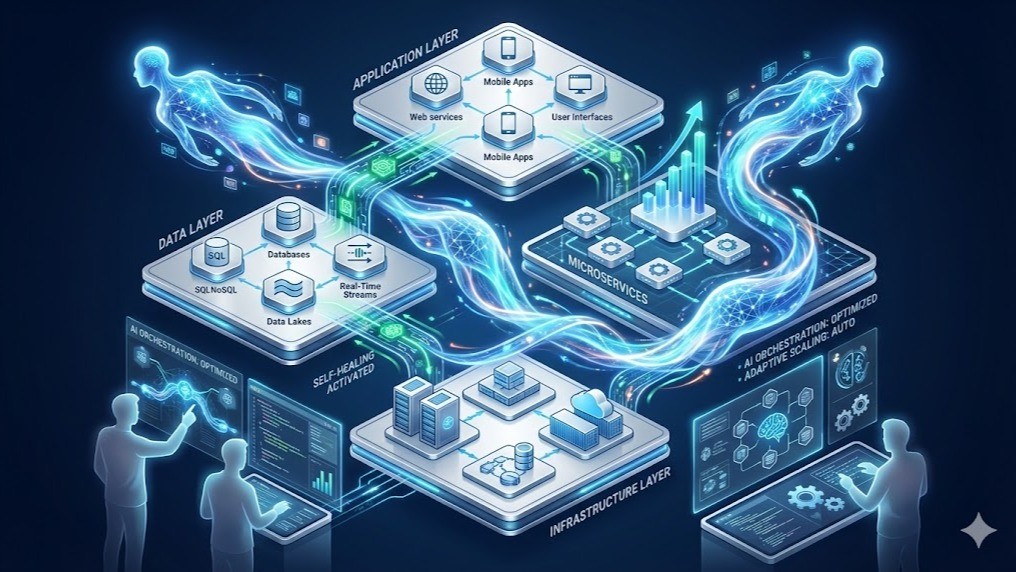
The biggest technology revolutions do not always arrive with a dramatic announcement.
Sometimes, they happen quietly.
A new capability appears in a research laboratory. Businesses begin testing it. Developers build around it. Infrastructure improves. Costs decline. Adoption spreads.
Then, almost suddenly, something that once seemed experimental becomes ordinary.
That may be where the technology industry finds itself today.
Artificial intelligence is becoming embedded in everyday software. Robotics is becoming more capable. Cloud and edge computing are expanding. Blockchain infrastructure is moving into financial applications. Connected devices are generating enormous amounts of data, while advances in computing are creating new possibilities across industries.
None of these developments alone tells the entire story.
Together, however, they point toward something much larger: a quiet technological revolution that is beginning to accelerate.
The Revolution Is Happening Beneath the Surface
Technology headlines tend to focus on spectacular launches.
A new AI model.
A powerful smartphone.
A breakthrough chip.
A futuristic robot.
But technological transformation is rarely created by a single product.
It happens through infrastructure.
Data centers become more powerful. Networks become faster. Chips become more efficient. Software becomes easier to deploy. Algorithms improve.
Eventually, these improvements combine into platforms capable of supporting entirely new applications.
That process is already underway.
The most important technologies of the coming decade may not be those attracting the most attention today.
They may be the technologies quietly becoming infrastructure for everything else.
AI Is Becoming Part of the Operating Layer
Artificial intelligence is perhaps the clearest example.
When generative AI first entered mainstream awareness, much of the excitement centered around chatbots.
Users asked questions.
AI generated answers.
People experimented with writing, images, coding and research.
But the technology is rapidly moving beyond simple conversations.
AI is increasingly being integrated into search engines, productivity applications, software development tools, customer-service systems and business workflows.
The next stage could be even more significant.
AI agents are being developed to perform multi-step tasks, interact with applications and work toward defined objectives.
That changes the role of AI.
It is no longer simply a tool that waits for instructions.
It can potentially become an active layer within digital workflows.
Software Could Become More Autonomous
For decades, software has required users to tell it what to do.
Open an application.
Enter information.
Click a button.
Review the result.
Repeat.
AI could gradually change that model.
Instead of navigating through several applications, users may increasingly describe an objective in natural language and allow software to determine the steps required to complete it.
Imagine telling a digital assistant to prepare a financial report.
The system could potentially gather information, analyze the numbers, identify trends and create the report.
The user would focus less on operating software and more on reviewing the outcome.
That is a profound change in how humans interact with computers.
The Computing Race Is Getting Bigger
Behind the AI revolution is another transformation that receives considerably less attention: the race to build computing infrastructure.
Advanced AI systems require enormous amounts of computational power.
That has increased demand for specialized processors, high-performance networking, advanced data centers and large-scale energy infrastructure.
The consequences extend beyond AI.
As computing becomes more powerful and accessible, technologies that previously required specialized environments can become commercially viable.
This is how technological ecosystems evolve.
Better infrastructure creates new capabilities.
New capabilities create new applications.
Those applications generate demand for even better infrastructure.
The cycle accelerates.
Robotics Is Moving Into a New Phase
Robotics could be another major beneficiary.
Traditional industrial robots are excellent at repetitive tasks in controlled environments.
But the next generation is being designed to operate in environments that are considerably less predictable.
Advances in AI, computer vision and machine learning are giving robots greater ability to interpret their surroundings and respond to changing conditions.
That could expand robotics into warehouses, hospitals, agriculture, logistics and eventually everyday environments.
The important change is not simply that robots are becoming stronger or faster.
They are becoming more adaptable.
A machine that can understand its environment is capable of handling a much broader range of tasks.
The Physical and Digital Worlds Are Converging
Technology is also becoming increasingly connected to the physical world.
Sensors can monitor machines.
Connected devices can collect environmental information.
Vehicles can analyze their surroundings.
Factories can track production in real time.
Digital twins can create virtual representations of physical systems.
This creates a feedback loop between the physical and digital worlds.
A machine produces data.
Software analyzes it.
AI identifies a potential problem.
An automated system responds.
The physical environment changes.
New data is generated.
The cycle begins again.
As this process becomes more sophisticated, industries could operate with far greater levels of automation.
Edge Computing Could Make Technology Faster
Cloud computing transformed how businesses process information.
But not every task can depend on a distant data center.
Some applications need decisions to happen almost immediately.
Autonomous vehicles are one example.
Industrial machinery is another.
Smart cameras, medical devices and connected infrastructure can also generate data that needs to be processed quickly.
Edge computing addresses this by moving some computing power closer to where data is generated.
The combination of edge computing and AI could create systems capable of responding to their environments in real time.
That could become particularly important as autonomous technologies expand.
Blockchain Is Becoming Infrastructure
Blockchain is experiencing a quieter transformation of its own.
The technology was once almost synonymous with cryptocurrency speculation.
Today, the conversation is increasingly focused on infrastructure.
Financial institutions are exploring tokenized assets.
Payment providers are investigating stablecoins.
Businesses are experimenting with blockchain-based records and digital ownership.
The World Economic Forum has identified tokenization and blockchain infrastructure as significant developments in the evolution of digital finance.
This suggests a different path for blockchain adoption.
Instead of replacing existing systems overnight, blockchain could gradually become part of the infrastructure supporting them.
That kind of transition rarely makes dramatic headlines.
But it can have enormous long-term consequences.
Quantum Computing Is Waiting in the Background
While AI and robotics are moving rapidly toward commercial applications, quantum computing represents a longer-term technological frontier.
Quantum computers use fundamentally different computational principles from conventional machines.
Their potential applications include complex optimization, materials science, drug discovery and cryptography.
However, significant engineering challenges remain.
Quantum systems are difficult to operate, and researchers continue working toward reliable large-scale machines capable of delivering practical advantages.
That means quantum computing may not transform everyday technology immediately.
But progress in the field could eventually create capabilities that conventional computing cannot easily reproduce.
It is one of the technologies worth watching precisely because its biggest impact may still be ahead.
Connectivity Is Becoming More Important
As technology becomes more intelligent, connectivity becomes increasingly critical.
AI systems need data.
Autonomous machines need communication.
Smart devices need networks.
Businesses need information to move between systems.
This is driving demand for faster and more reliable connectivity.
But the future of networking is not simply about speed.
It is about reliability, responsiveness and the ability to connect enormous numbers of devices.
That becomes particularly important as industrial systems and autonomous technologies increasingly depend on real-time communication.
Technology Is Becoming Less Visible
There is an interesting paradox emerging.
As technology becomes more powerful, people may interact with it less directly.
The best AI system may not require users to open an AI application.
The best blockchain implementation may not require users to know that blockchain exists.
The best automation may eliminate repetitive software interactions altogether.
This is often the final stage of technological adoption.
The technology becomes invisible because it works.
Electricity is rarely discussed when someone turns on a light.
The internet is rarely considered when someone sends a message.
Artificial intelligence and advanced digital infrastructure could eventually become just as ordinary.
Businesses Are Moving From Experiments to Deployment
Another sign of acceleration is the changing attitude of businesses.
During the early stages of an emerging technology, companies experiment because they want to understand the possibilities.
Eventually, experimentation gives way to implementation.
Businesses begin asking different questions.
Can this reduce costs?
Can it improve productivity?
Can it generate revenue?
Can it scale?
Can it integrate with existing systems?
Those questions are now being asked across AI, automation, cloud infrastructure, robotics and blockchain.
That is a major indicator of maturity.
The Battle Will Be About Efficiency
The next stage of technological competition will not simply be about creating the most powerful systems.
It will also be about creating systems that are efficient.
AI models need to become cheaper to operate.
Robots need to become affordable.
Data centers need to use energy efficiently.
Networks need to handle increasing amounts of information.
Blockchain systems need to scale economically.
Technology that provides extraordinary capabilities but costs too much to operate will struggle to achieve mass adoption.
Efficiency could therefore become one of the defining competitive advantages of the next technology cycle.
Security Cannot Be an Afterthought
Greater connectivity also creates greater risk.
As more systems become automated, the consequences of a security failure become more serious.
A compromised account is one problem.
A compromised industrial system, autonomous vehicle or financial network is something else entirely.
Cybersecurity will therefore need to evolve alongside emerging technology.
AI can help detect threats, but attackers can also use AI to become more sophisticated.
Connected devices increase convenience but create additional attack surfaces.
Blockchain can provide transparency but smart-contract vulnerabilities can still create risks.
The technological revolution will therefore require an equally significant security revolution.
Regulation Will Shape the Speed of Change
Governments are also trying to keep pace.
Artificial intelligence raises questions about privacy, accountability and transparency.
Autonomous systems create questions about safety and liability.
Blockchain raises questions about financial regulation and digital ownership.
Emerging technologies often develop faster than legislation.
That creates tension.
Clear rules can encourage investment by reducing uncertainty.
Poorly designed rules can slow innovation or push companies toward more favorable jurisdictions.
The balance will be difficult to achieve.
But regulation will undoubtedly influence which technologies reach widespread adoption and how quickly they do so.
The Real Revolution Is Convergence
Perhaps the most important development is that these technologies are beginning to converge.
AI can provide intelligence.
Robotics can provide physical action.
Cloud and edge computing can provide processing power.
Advanced connectivity can provide communication.
Blockchain can provide programmable ownership and digital records.
Quantum computing could eventually provide new computational capabilities.
Individually, each technology is significant.
Together, they could create something much larger.
An autonomous factory could combine AI, robotics, edge computing and advanced connectivity.
A future financial platform could combine AI, blockchain, tokenization and automated settlement.
A smart vehicle could combine AI, sensors, edge computing and real-time connectivity.
The boundaries between technology categories are becoming increasingly difficult to maintain.
What Comes Next?
The quiet revolution underway today may therefore be less about individual gadgets and more about the creation of an entirely new digital infrastructure.
The most important changes could happen behind the applications people already use.
AI will increasingly handle complex tasks.
Automation will remove repetitive processes.
Robots will become more capable.
Connected systems will become more responsive.
Blockchain could support new forms of digital ownership and financial infrastructure.
Advanced computing will continue pushing the limits of what is possible.
And as these technologies converge, entirely new products and industries could emerge.
The Quiet Phase May Not Stay Quiet
Technology history is full of moments that appeared insignificant at first.
The early internet did not immediately look like the foundation of a global economy.
Cloud computing initially seemed like another way to host software.
Smartphones began as communication devices before becoming platforms for much of modern digital life.
Emerging technologies often follow the same pattern.
They begin as experiments.
They become useful.
They become infrastructure.
Then they become unavoidable.
That may be the stage the technology industry is approaching now.
The revolution is not necessarily waiting for one spectacular breakthrough.
It is being built through thousands of incremental improvements happening simultaneously.
And once those improvements begin reinforcing one another, the pace of change can accelerate quickly.
The most intriguing question is no longer whether technology will transform the future.
It is how much of that transformation is already happening without us noticing.